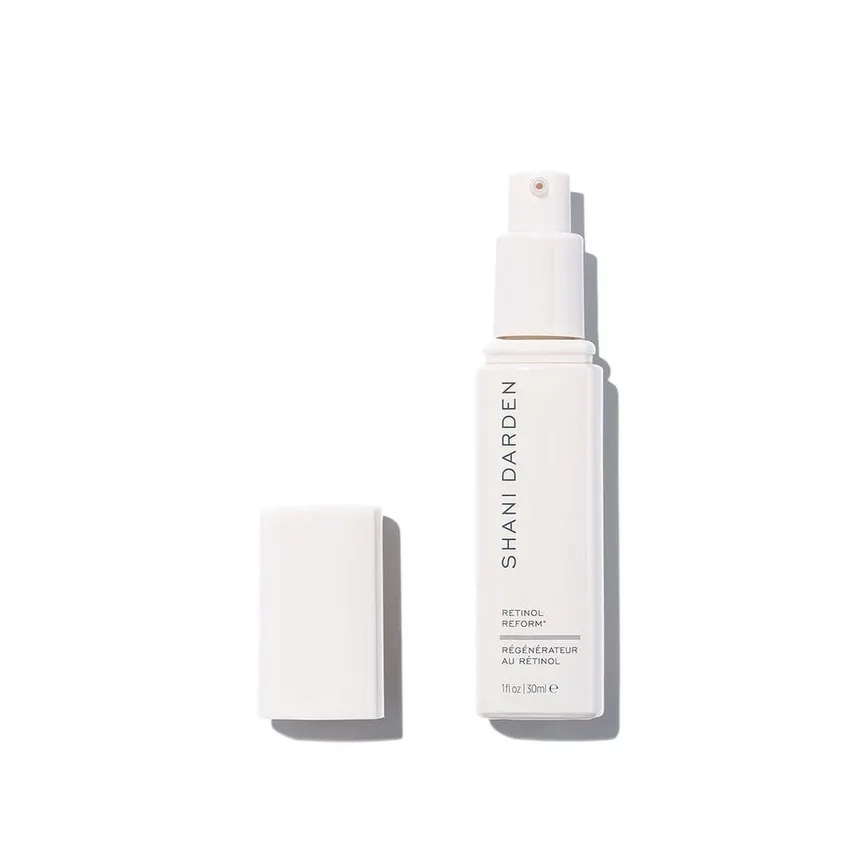
Shani Darden is a Los Angeles-based celebrity facialist whose client roster — Jessica Alba, Rosie Huntington-Whiteley, Chrissy Teigen, among others — appears in every brand mention and functions as both marketing asset and implicit credential. Celebrity associations in skincare warrant the same scrutiny as any other brand claim. What matters is whether the formulation behind the name delivers what the name implies.
For the Retinol Reform with 1% Encapsulated Retinol — the brand's hero product and the one in our scoring database — the answer is an unambiguous yes. It earns a Tier S score of 9.0/10, driven by a 9.5 on Results and a 9.5 on Brand Trust. Those are not numbers a brand coasts to on celebrity reputation alone. They reflect a formulation with genuine clinical efficacy and a delivery mechanism that represents a meaningful advance on standard retinol.
This review covers what makes a celebrity facialist's formulations credible versus merely well-marketed, the science behind encapsulated retinol and why the delivery mechanism matters, the detailed score breakdown, the broader Shani Darden lineup, and an honest accounting of who this brand is and is not for.
What "Celebrity Facialist" Actually Means for Formulation Credibility
The celebrity facialist brand category has a mixed track record. A facialist who treats famous clients develops real expertise in skin behavior, ingredient response, and the gap between what the industry promises and what the skin actually needs. That expertise can produce genuinely well-formulated products — or it can be licensed to a cosmetic chemist and produce a prestige-branded version of a commodity formula at a significant markup.
The distinguishing factors are the same ones that distinguish any credible skincare brand: disclosed active ingredients at disclosed concentrations, a coherent formulation rationale, and results that correspond to the mechanism claimed.
Shani Darden's Retinol Reform passes this test on all three counts. The active — 1% encapsulated retinol — is a specific and meaningful choice, not a generic "retinol complex." The delivery mechanism (encapsulation) is a real formulation technology with a real effect on tolerability. The co-actives — lactic acid, niacinamide, glycerin — form a coherent system: one accelerates cell turnover via a second mechanism, one supports the barrier and reduces inflammation, one maintains hydration. The formulation logic is visible and sound. For how brand transparency factors into our scoring, see the full scoring methodology.
The Science Behind Encapsulated Retinol — Why the Delivery Mechanism Matters
Standard retinol is active on contact — it begins converting to retinoic acid in the skin immediately upon application. This is efficient and effective, and it is also why standard retinol at 1% causes the purging, peeling, and redness that leads many users to abandon the category before seeing the results. The irritation is not inevitable; it is a function of how quickly the active is presented to the skin.
Encapsulated retinol surrounds the retinol molecule in a polymer shell that releases the active slowly and evenly as the polymer degrades on the skin. The same 1% concentration is delivered, but the rate of delivery is controlled — the skin receives a lower dose per unit time, which allows the barrier and the skin's own retinoid receptors to adapt without the acute inflammatory response of the full dose hitting at once. The result is a formula that achieves comparable retinol results on a slightly longer timeline with substantially lower irritation incidence.
The lactic acid co-formulation is a deliberate pairing, not a coincidence. Lactic acid is an AHA that accelerates surface cell turnover — meaning the Retinol Reform achieves faster texture resurfacing than encapsulated retinol alone would, while the encapsulation manages the irritation risk that this combination would carry in a less carefully designed formula. The niacinamide provides barrier-supportive and anti-inflammatory support that further buffers the active intensity. Our guide to retinol vs retinoids covers the full mechanism of retinoid activity and how encapsulated forms compare to standard and prescription options.
Tier S — Retinol Reform with 1% Encapsulated Retinol · 9.0/10 · $88
The only Shani Darden product in our scoring database — and the one that earns the brand its place in our top-rated lineup.
The Shani Darden Retinol Reform is a PM-only serum applied after cleansing and toning, before moisturizer. The 1% encapsulated retinol is the primary active, with lactic acid (AHA), niacinamide, and glycerin as the supporting system. Apply a pea-sized amount to full face, avoiding the immediate eye area. Begin every other night for the first two to four weeks before building to nightly use.
Score breakdown: Results 9.5 · Brand Trust 9.5 · Aesthetic & Packaging 9.0 · Feel & Experience 8.5 · Ingredients & Safety 8.5 · Skin Compatibility 8.5 · Price Value 8.5 · Ease of Use 8.0.
The 9.5 on Results is the score this formula earns in use: visible texture refinement, reduction in the appearance of fine lines, and improvements in skin tone evenness over a four-to-six-week consistent use period — earlier than most retinol products at equivalent concentrations. The 9.5 on Brand Trust reflects both the esthetician credentials behind the formulation and the product's record of consistent performance, which is what drives the word-of-mouth this brand runs on.
The 8.0 on Ease of Use is honest: retinol requires an introduction period, and Retinol Reform is no exception. The encapsulation makes it more tolerable than standard 1% retinol, but starting users who apply it nightly from day one and skip SPF in the morning will still experience the sensitivity and photo-reactivity that retinol produces. This is a product that rewards correct use, and correct use has a learning curve.
The 8.5 on Price Value reflects that $88 for a 1-fl-oz retinol serum is a premium spend — higher than budget retinol options, lower than luxury tier. What the 8.5 says: the price is earned by the formulation quality and the results, but it is not a bargain. For the score of a premium retinol product used as an active cornerstone, $88 is defensible.
Age-decade scores: 30s 9.5 · 40s 9.0 · 20s 8.5 · 50s 8.5 · 60s+ 7.5. The formula peaks in the 30s and 40s, which reflects where retinol-driven collagen support and texture resurfacing produce the most visible and cumulative return. The 7.5 at 60s+ reflects a real consideration: very dry, sensitized, or retinol-naive mature skin may not tolerate 1% encapsulated retinol as a starting point, and should consider introducing retinol at lower concentrations before graduating to this formula. For skin in its 50s where retinol tolerance has been established, the 8.5 score is the accurate expectation. For those starting retinol later in life, our guide to the best retinol serums covers entry-level options.
The Broader Shani Darden Lineup
We have scored the Retinol Reform in our database. The Shani Darden lineup also includes the Texture Reform, a lactic acid-based resurfacing toner; a gentle cleanser; and a line of moisturizers and sunscreens — all built around the same philosophy of clinical efficacy delivered with as little unnecessary irritation as possible. The full lineup is available through the Shani Darden brand site.
The Texture Reform deserves mention specifically: it is a lactic acid-based exfoliating toner positioned as a gentler entry point into the Shani Darden routine than the Retinol Reform, and as a complement to it in an alternating-nights protocol. For skin new to actives or new to this brand, Texture Reform as an introduction followed by Retinol Reform is the rational progression. For the full picture of how lactic acid and retinol work in combination, and why alternating rather than layering is the right approach, see our hyperpigmentation serum guide for the protocol that applies.
Where Shani Darden Excels — and Who It's For
Shani Darden is the right brand if active-focused, results-driven skincare is what you are after; if you have some existing experience with retinol or exfoliants and understand what an introduction period requires; and if the $88 spend on the Retinol Reform represents the right trade-off for a Tier S formula that consistently delivers on texture, tone, and fine lines.
It is not the right brand if you want clean beauty with third-party certification — Shani Darden does not hold EWG Verified, MADE SAFE, or equivalent certifications. The formulation is cruelty-free and uses well-tolerated actives, but it is a clinical brand rather than a clean beauty brand in the certification sense. It is also not the right starting point for retinol-naive skin, very dry skin, or skin with active rosacea or significant sensitivity — the 1% retinol concentration, even encapsulated, requires a functioning barrier and some retinol tolerance to introduce without disruption.
For those on a budget who want retinol results at a fraction of the price, Amazon carries RoC Retinol Correxion and Neutrogena Rapid Wrinkle Repair — lower concentration, less elegant formulation, but genuine retinol at an accessible price point. The Retinol Reform earns its premium. The premium is real.
The Bottom Line
Shani Darden Retinol Reform is one of the best retinol serums in our database at any price point — Tier S at 9.0/10, with a 9.5 on Results that reflects what the encapsulated delivery mechanism actually achieves in consistent use. The brand's celebrity association is marketing. The formulation is the substance. For an active-focused routine built around retinol, the Retinol Reform earns its place as a cornerstone product.
Use the comparison tool to stack the Retinol Reform against other serums in our database across all eight scoring dimensions.
This post contains affiliate links. We may earn a commission if you purchase through them, at no cost to you. Affiliate relationships do not influence our scores or recommendations.